en
en Español
 Русский
 عربي
عربي Português
 Italiano
 Français
 Türkçe
 Tiếng Việt
 แบบไทย
What is insulating glass? A complete analysis of its advantages, selection and application

In modern architecture and home decoration, the choice of glass is crucial, and hollow glass has gradually become the first choice for many people due to its excellent performance. This article will give you a detailed introduction to the relevant knowledge of hollow glass to help you fully understand hollow glass.
1. What is hollow glass?
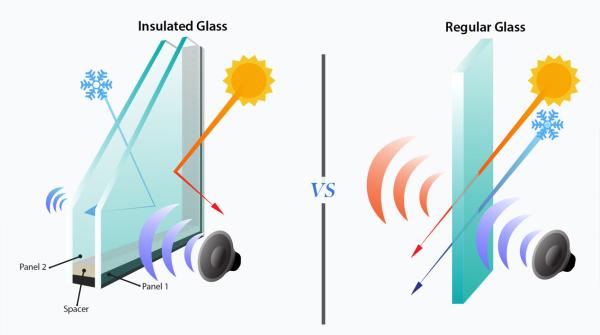
Insulating glass is composed of two or more pieces of flat glass, which are sealed by effective sealing materials and spacer materials, and desiccant is embedded around it to ensure the dryness of the air between the glasses. It is not a simple glass stacking, but a composite glass product processed by special technology.
2. Advantages of hollow glass
Excellent thermal insulation performance: The air layer or inert gas layer in the middle of the hollow glass can effectively block the transfer of heat. In summer, it can reduce the outdoor heat entering the room and reduce the energy consumption of air conditioning; in winter, it can prevent the indoor heat from escaping to the outside, keep the indoor temperature stable, and achieve energy-saving effects.
Good sound insulation effect: The air layer can play a certain role in hindering the propagation of sound and effectively reduce the introduction of external noise. For noise-sensitive places such as houses facing the street, schools, and hospitals, hollow glass is an ideal choice.
Anti-condensation performance: Since hollow glass has good heat insulation, it can reduce the temperature change on the glass surface, thereby reducing the possibility of condensation. This not only ensures the clarity of the glass, but also avoids moisture damage to window frames and walls caused by condensation.
Extend the service life of glass: The sealing structure of hollow glass can effectively prevent dust, water vapor, etc. from entering the interior of the glass, reduce the chance of glass corrosion and pollution, and extend its service life.
3. Key points for purchasing hollow glass
Look at the original glass: High-quality hollow glass usually uses float glass original glass, which has a flat surface, high transparency, and no defects such as bubbles and impurities. The quality of the original glass can be judged by observing the flatness and transparency of the glass.
Check the sealing performance: Sealing is the key to hollow glass, and good sealing can ensure the stability of its performance. When purchasing, you can check whether the sealant of the glass is uniform and full, and whether there is any cracking or falling off. At the same time, you can check whether there is a desiccant to ensure the dryness of the air layer.
Select spacers: The material and quality of the spacers will also affect the performance of hollow glass. Common spacers include aluminum bars and warm edge bars. Aluminum bars have strong thermal conductivity, while warm edge bars can reduce heat transfer and save energy. You can choose the appropriate spacer according to your needs.
Look at the brand and reputation: Choose well-known brands of insulating glass, and its quality and after-sales service are more guaranteed. You can learn about the brand's reputation by checking user reviews and consulting professionals.
Fourth, the installation and maintenance of insulating glass
Installation precautions: When installing insulating glass, ensure that the window frame is flat and firm to avoid squeezing the glass. At the same time, the sealant should be applied evenly to ensure the sealing effect.
Daily maintenance: Usually pay attention to keep the glass surface clean, and wipe it with a soft cloth dipped in water or a neutral detergent. Avoid hitting the glass with hard objects to avoid damage. If you find that the glass is foggy, water droplets, etc., it may be that the sealing performance has decreased. You should contact professionals in time to deal with it.
Five, the market trend of insulating glass
With the improvement of people's requirements for building energy conservation and living environment, the market demand for insulating glass continues to grow. In the future, insulating glass will develop in the direction of being more energy-efficient, more environmentally friendly and multifunctional. For example, Low-E insulating glass and inert gas-filled insulating glass will be more widely used.
In short, insulating glass plays an important role in the fields of architecture and home furnishing with its excellent performance. I hope that through the introduction of this article, it can help you better understand insulating glass and make wise decisions when purchasing and using it.